



Unlock the White House Watch newsletter for free
Your guide to what Trump’s second term means for Washington, business and the world
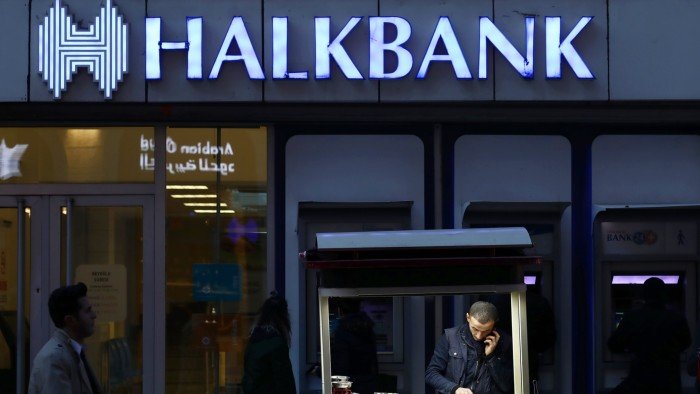
The US Supreme Court has rejected an appeal by Turkey’s Halkbank, leaving the state-controlled lender to face criminal charges that it helped Iran to evade economic sanctions and launder billions of dollars through the American financial system.
The court refused to consider Halkbank’s claim that it is protected from prosecution by sovereign immunity. The bank’s share price closed down 10 per cent on the Istanbul stock exchange.
The case, first brought by US federal prosecutors in 2019, has long been a thorn in bilateral relations, with Turkey’s president, Recep Tayyip Erdoğan, calling it at the time an “unlawful, ugly” step.

Erdoğan discussed the issue when he met US President Donald Trump at the White House late last month. Both sides have painted the meeting as a reset of strained relations between the two Nato allies.
Manhattan federal prosecutors alleged Halkbank secretly transferred $20bn of restricted Iranian funds and helped launder at least $1bn through the US financial system, violating federal law that allows fines of up to twice the transaction value.
If found guilty the bank could face a penalty of as much as $2bn — equivalent to more than three times last year’s consolidated net profit of TL23.2bn ($556mn).
However, Halkbank, more than 90 per cent owned by the Turkish state, said in a stock exchange filing that the Supreme Court’s decision “does not mean that the legal proceedings are finalised”.
“Initiatives to find a legal consensus within the framework of agreements between the United States and Türkiye are also continuing in a positive direction,” it said.
The bank has long argued it is immune from prosecution because it is majority-owned by the Turkish state, that its conduct occurred outside the US and it is beyond the jurisdiction of US courts.
But a federal appeals court rejected its immunity defence last year, after which the bank filed an appeal to the Supreme Court.
It is not unusual for the Supreme Court to decline to consider an appeal. The top court typically turns down most of the petitions it receives every year.
The Halkbank case was an important flashpoint in the relationship between Manhattan federal prosecutors and the Department of Justice in Washington during Trump’s first term.
The DoJ “kept trying to stop” New York prosecutors from bringing criminal charges against the bank, Geoffrey Berman, then-US attorney for the Southern District of New York, wrote in his 2022 book Holding the Line.
He said that while he could not be sure of the reasons for this, Trump “was close with” Erdoğan, who had attended the opening of Trump Towers Istanbul in 2012. But in October 2019, then-US attorney-general William Barr enabled the case to be indicted, Berman wrote, adding: “Apparently, Trump had fallen out with Erdoğan.”
The DoJ and the White House did not immediately respond to requests for comment.
Turkish officials did not immediately respond to a request for comment.
Last week, Turkey separately froze the assets of dozens of Iranian entities and individuals tied to Tehran’s nuclear and missile programmes in a move that followed and complied with the UN Security Council “snapback” sanctions.
The US Treasury department also imposed sanctions on 21 companies and 17 individuals accused of supporting Iran’s ballistic missile and military aircraft programmes.



