




On October 8, 2025, Bollinger Innovations, Inc. (the “Company”) received written notification from the Listing Qualifications Staff (the “Staff”) of The Nasdaq Stock Market LLC (“Nasdaq”) that trading in the Company’s securities will be suspended at the open of trading on Monday, October 13, 2025.
FT Alphaville readers can be forgiven for not having heard of Bollinger Innovations, given it’s a pretty new name for a relatively small company. Until July this year, the company was known as Mullen Automotive Inc.
And boy did they do numbers. As George writes for Unhedged:
Since 2015, the electric-vehicle manufacturer [has] racked up huge losses and received at least eight delisting notices, almost always for failing to maintain a $1 share price for 10 consecutive business days. Until this week, Mullen had Houdini’d its way out of trouble every time, with no less than nine reverse splits to its name since 2021, more than any other Nasdaq stock.

Reverse stock splits — aka stock consolidations — slash the number of circulating shares while proportionally inflating their price. You can see why companies trying to meet minimum bid price requirements might find them appealing.
The output of this interesting market engineering is Mullen’s adjusted graphs are absolutely bonkers.
Before we get into it, a quick primer. Big numbers follow this format: thousand, million, billion, trillion, quadrillion, quintillion, sextillion — with each a thousand times the size of the one that came before.
With that in mind, here’s what you’ll see if you grab your nearest Bloomberg Terminal and call up the share-price graph of Bollinger Innovations (née Mullen):
You’re not misreading, that is indeed a split-adjusted peak share price of $1,443,628,805,578,030,000.
If you’re struggling to pronounce that number, it’s: one quintillion, four hundred and forty-three quadrillion, six hundred and twenty-eight trillion, eight hundred and five billion, five hundred and seventy-eight million and thirty thousand dollars.
But that chart is, obviously, kind of a lie.
We can view an unadjusted version, which shows us an altogether more reasonable and depressing picture of Mullen/Bollinger’s share price:
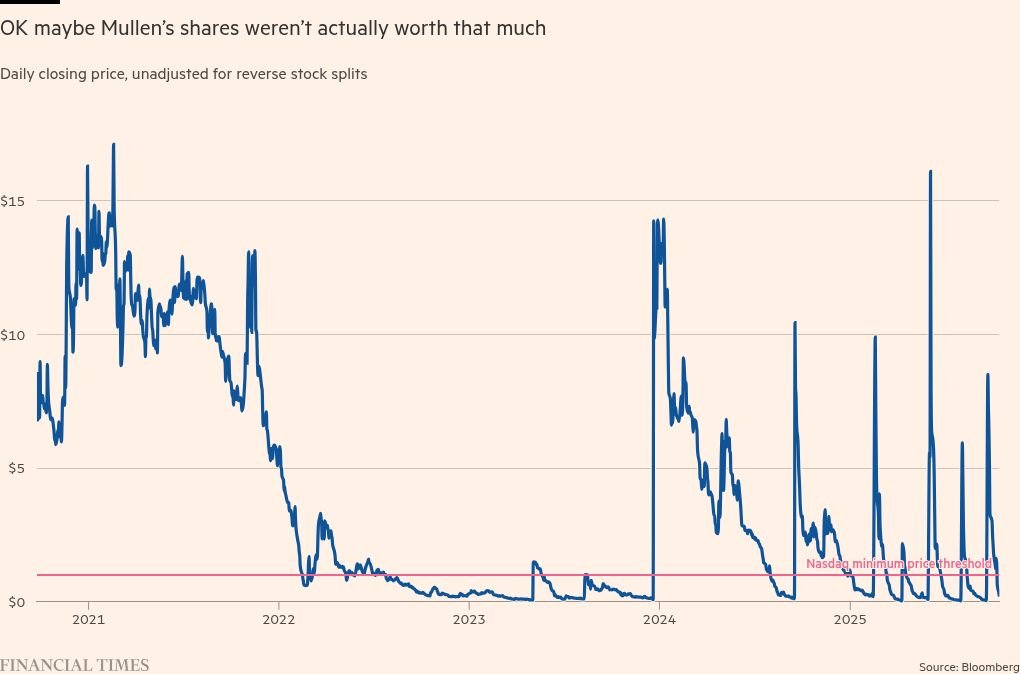
Around these efforts to consolidate its existing shares and stay afloat on Nasdaq, Mullen was also diluting existing shareholders to keep the business running by selling hundreds of millions of dollars worth of convertible notes and warrants. Call it the ‘juice-and-sluice’ public market strategy. Long story short, it didn’t save them.
But where’s the fun in all those practicalities? There are big numbers to be found!
To get there, let’s briefly remind ourselves how reverse splits work practically with an illustrative example.
Pete and Andromeda are co-shareholders in a company with 20 shares total. Each owns 10 shares each worth $1 apiece, giving the company a market cap of $20. They want to get the share price up to $10, so they undertake a 1-for-10 reverse stock split, and convert their 10 shares into one. The company now has two shares, each worth $10. Its market cap is unchanged, and the value of Pete and Andromeda’s stakes are unchanged, but the share price is up.
Looking at this backwards, one share is equivalent to 10 pre-split. Simple enough.
But let’s imagine this isn’t the first time such a split has occurred. What if Pete and Andromeda originally had 250 shares each, before reducing them to 10 via a 1-for-25 reverse stock split?
Going backwards from that point would mean the single share they’ve been left with post the second split is equivalent to 250 of the original shares, ie 25 times 10.
Now, Mullen reverse-split its shares in *checks filings* September, August, June, April and February this year; September 2024; and December, August and May 2023. Here’s the breakdown:
Apply the same logic as above, and one share in Mullen/Bollinger now is equivalent to (1*250)*250)*100)*100)*100)*60)*100)*100)*9)*25) pre-splits.
Which is 84,375,000,000,000,000. Which is eighty-four quadrillion, three hundred seventy-five trillion (the number you can divide the $1.4 quintillion share price above by to get the actual peak, of about $17).
The fun may finally have stopped. Here’s how the company announced September’s reverse split:
Bollinger Innovations Commits to Long-Term Stability, Announces NO Further Reverse Stock Splits for Next 3 Years
BREA, Calif., Sept. 23, 2025 (GLOBE NEWSWIRE) — via IBN — Bollinger Innovations, Inc. (NASDAQ: BINI) (“Bollinger Innovations” or the “Company”), an electric vehicle manufacturer, today announces that the reverse stock split (“Reverse Stock Split”) of its common stock that went into effect on Sept. 22, 2025, at 12:01 a.m. Eastern Time is expected to be the last reverse stock split the Company will implement for at least the next three years.
And the music really does seem to have stopped — there was no deus ex machina, and Mullen/Bollinger duly exited the Nasdaq this past Monday.
There’s a slim chance it returns. On Friday, activist investor Jourdan Matthews at Seattle-based Winvest Investment Fund said he was interested in acquiring a majority stake in the car company “to improve operations”. In a press release, he said:
The company has absolutely vast potential — only if it uses its most valuable asset, which I am proposing the company unleash immediately.
What asset could justify such optimism? A cleanser? A fat-free fudge cake that doesn’t let you down in the flavour department? A cave troll? Winvest declined to explain.
A person close to Winvest told us that any tender offer was contingent on Mullen reversing its decision to move to OTC Markets — they added that David Michery, Mullen’s chief executive, “could still appeal” the delisting.
If that fails, and this is the end, will we ever see such implausible numbers again? OpenAI, you’re our only hope.



