


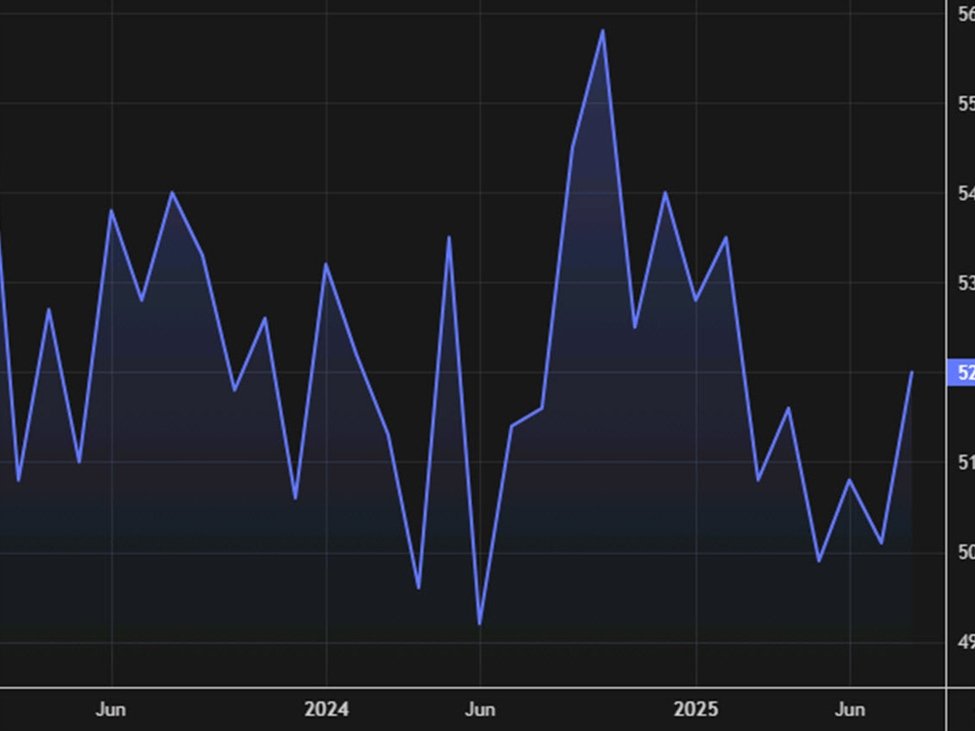

- Prior was 52.0
Details:
- Business activity 49.9 vs 51.8 expected (prior was 52.0)
- Prices paid 69.4 vs. 69.2 last month
- Employment 47.2 vs. 46.5 last month — fourth month in contraction
- New orders 50.4 vs. 56.0 last month
- Supplier deliveries 52.6 vs. 50.3 last month
- Inventories 47.8 vs. 53.2 last month
- Backlog of orders 47.3 vs. 40.4 last month
- Exports 46.5 vs. 47.3 last month
- Imports 49.2 vs. 54.6 last month
- Full report
That new orders number is a problem, though it’s more of a reversion to the range from Jan-July rather than a fresh deterioration. The employment number was a tad better but still well-below 50, which indicates a slow deterioration in employment in the absence of the non-farm payrolls report.
Comments in the report:
- “We are beginning to see the impact of the tariffs impact our
business, particularly for food products from India, China, and
Southeast Asia, coffee from South America, and apparel and electronics
from Asia. Our year-over-year cost increases are getting progressively
greater.” [Accommodation & Food Services] - “New residential construction continues to struggle in a tough
market. Housing values remain high, and tariffs are beginning to be
passed through on materials that are metal based. The pace of housing
starts has been stagnant to slightly declining, as we head out of the
summer building season.” [Construction] - “Pharmacy costs continue to rise, and medical devices are being held
at bay mainly due to contracts and continued negotiations where we have
two to three sources for a given product.” [Health Care & Social
Assistance] - “Demand for artificial intelligence (AI) and cloud infrastructure
remains very strong. Our primary focus this month was on increasing
production throughput to begin clearing the significant order backlog
built up over the summer. While new order intake has stabilized at a
high level, the overall business outlook remains positive. We are still
facing significant supply chain challenges, especially for advanced
semiconductors and power components, with lead times remaining extended.
Price pressures are still present but have not worsened compared to the
previous month.” [Information] - “Client demand in professional services remains steady, though
decision-making timelines are lengthening due to continued economic
uncertainty and interest-rate concerns. We are also seeing modest upward
pressure on labor costs, which impacts both our internal resourcing and
supplier pricing.” [Professional, Scientific & Technical Services] - “Growing apprehension regarding state efforts to reduce or eliminate
property taxes that are a major revenue source for local governments.
And continuing concern about future economic conditions, inflation,
tariffs and their impact on increased prices.” [Public Administration] - “The overall housing market remains stagnant, which has forced our
company to be hyper-vigilant about costs. However, we are growing and
increasing our market share despite the headwinds. Tariffs continue to
inject an unnecessary level of uncertainty across the broader economy,
and costs are now beginning to increase with the full effect of the
tariffs now coming into play.” [Real Estate, Rental & Leasing] - “Costs overall have stabilized, and we’ve not seen any interruptions in sourcing or shipments.” [Retail Trade]
- “We’ve had more tariff charges last month than in previous months.” [Utilities]
- “Business conditions continue to soften, even in markets that have
historically been more resilient. Demand is simply weak.” [Wholesale
Trade]
This article was written by Adam Button at investinglive.com.




