



Unlock the Editor’s Digest for free
Roula Khalaf, Editor of the FT, selects her favourite stories in this weekly newsletter.
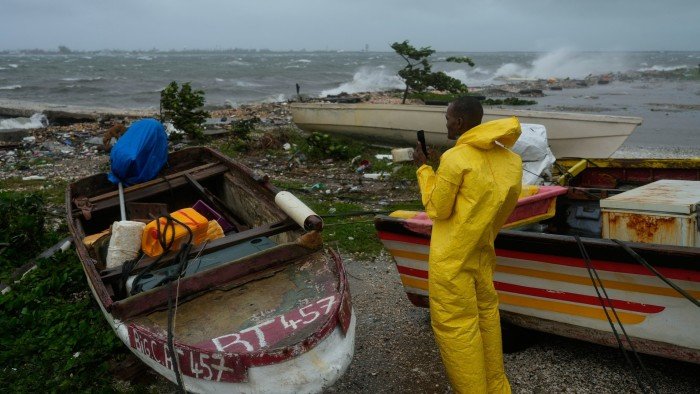
Investors are expecting to pay as much as $150mn to Jamaica, as the severity of Hurricane Melissa triggers “catastrophe bond” insurance to help the country to recover.
Melissa, expected to sweep through the Caribbean island nation on Tuesday, has strengthened to a Category 5 storm, the most severe on the Saffir-Simpson scale of hurricane wind strength, suggesting it will destroy homes and power lines and leave affected areas uninhabitable for weeks or months.
Investors in a 2024 Jamaica catastrophe bond predicted that the bond, which was arranged by the World Bank, would pay out at least $45mn and that damage from Melissa could exhaust the bond’s $150mn principal.

Many catastrophe bonds pay out on pre-agreed triggers, enabling help to get to where it is needed more quickly than would be the case with traditional insurance cover.
The World Bank has arranged billions of dollars of such deals for developing countries in recent years, including the Philippines and Mexico, in an effort to manage the mounting financial toll of natural catastrophes.
A payout on Jamaica’s bond would test a fast-growing market that can provide investors with higher returns than government bonds, and has allowed governments and insurance companies to transfer risk to capital markets as an alternative to traditional reinsurers.
Investors in catastrophe bonds take bets that specified events — such as hurricanes, earthquakes or wildfires — will not occur or, if they do, will not meet the parameters that would trigger a payout. Bondholders receive coupon payments but if a bond’s parameters are crossed it defaults and they may lose all their initial investment.
A Swiss Re index of catastrophe bonds has returned just under 10 per cent so far this year, while issuance has run at record levels.
The Jamaica bond’s parameters are based on a storm’s path and barometric pressure, a measure of intensity. It pays investors an annual yield of about 7 per cent.
The US National Oceanic and Atmospheric Administration has recorded Hurricane Melissa’s minimum central pressure at 901 millibars, the lowest and most intense for a Caribbean storm so far this year.
“We’re almost certain that the bond will be triggered,” said Dirk Schmelzer of Zurich-based bondholder Plenum Investments.
The storm is being closely monitored after investors in the bond narrowly avoided a payout last year, when Hurricane Beryl slammed into Jamaica.
Despite widespread damage and multiple deaths, the storm fell shy of a parameter that would have triggered payout, prompting criticism of catastrophe bonds. This time, Schmelzer said “the path of the hurricane has narrowed so much, it will certainly cross the boxes that define this trigger”.
“If a bond defaults, we don’t classify it as a bad investment,” he added. “Ultimately, the underlying insurance contract at some point will be triggered. We figure that in.”
Primary insurance companies including Allstate, State Farm and Florida’s Citizens Property Insurance Corporation have been among the largest issuers of catastrophe bonds to date, according to specialist data provider Artemis.
In addition to national governments, municipal and public authorities such as New York City’s Metropolitan Transportation Authority have used the bonds to secure insurance cover.
The World Bank declined to comment.
Brokers said that even a full loss was unlikely to damp investor demand for catastrophe bonds, or to raise the cost of securing insurance cover from capital markets. Broader losses from Hurricane Melissa were expected to be in the low single-digit billions, one broker predicted.
The already-falling cost of property reinsurance would continue to decline, brokers said, following a 2025 Atlantic hurricane season with relatively low losses and as more capital has flowed into the reinsurance sector from alternative investors, including hedge funds.
Climate Capital
Where climate change meets business, markets and politics. Explore the FT’s coverage here.
Are you curious about the FT’s environmental sustainability commitments? Find out more about our science-based targets here



