




Stay informed with free updates
Simply sign up to the Cryptocurrencies myFT Digest — delivered directly to your inbox.
Financial regulators are leaving too many gaps and inconsistencies when creating rules for the fast-growing cryptocurrency market, the world’s financial stability watchdog has warned.
Crypto asset providers and stablecoin issuers could take advantage of the uneven regulations by shopping around for the most compliant jurisdiction, the Financial Stability Board said in a landmark report published on Thursday.
“Different rules could lead to . . . dynamics which could exacerbate shocks,” John Schindler, secretary-general of the FSB, told the Financial Times in an interview. “These are things we wanted to avoid and now we are seeing them appear.”

The FSB’s warning came as the growing divergence on crypto regulation dominated many discussions between the world’s financial watchdogs as they met for the IMF and World Bank annual meetings in Washington this week.
The US has switched to a crypto-friendly approach since Donald Trump entered the White House this year, but that contrasts with the more sceptical approach of many European countries. China has banned most crypto activities, while other countries such as Mexico and India are yet to regulate the market.
Andrew Bailey, the Bank of England governor who also chairs the FSB, told an event in Washington that some countries were taking a “let a thousand flowers bloom” approach to encouraging crypto markets to develop. But he added there would soon have to be “some coming together” to agree on a more harmonised approach.
The FSB said its assessment of crypto regulations in nearly 40 jurisdictions had identified “significant gaps and inconsistencies that could pose risks to financial stability and to the development of a resilient digital asset ecosystem”.
Schindler said he was particularly concerned about the lack of regulation in many jurisdictions on the use of leverage in crypto markets, such as allowing users to borrow against their exposures or to use debt to magnify their trading positions.
The FSB said Bermuda and the Bahamas were the only two countries to comprehensively regulate crypto borrowing and lending activities, requiring providers of such services to manage counterparty risks and to maintain capital and liquidity buffers to absorb losses.
It warned that, without such guardrails, leverage in crypto markets could lead to “margin calls and cascading failures during market stress”.
The FSB also warned that many countries still lacked sufficient supervision and enforcement resources for the crypto market, “with many jurisdictions yet to implement the tools necessary for ensuring compliance and oversight”.
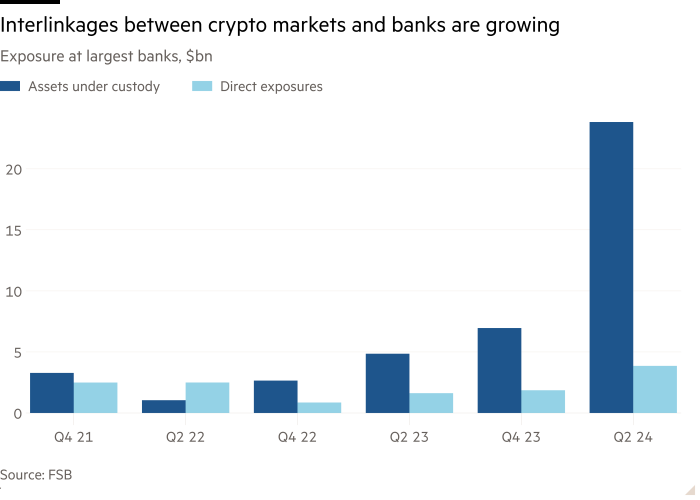
It found that interlinkages between crypto markets and traditional banks were growing but remained small. Big banks held less than $25bn of crypto assets as custodians for investors and had less than $5bn of direct crypto exposure by the second quarter of 2024, it said.
Schindler said regulators had made “a lot of progress” in setting rules for the fast-moving market in the past two years since the FSB published its global regulatory framework for crypto activities in 2023.
But he said authorities still needed to collect more information from crypto companies. “The amount of data we have on this sector is still significantly lagging [in areas] where we would need to do a comprehensive financial stability assessment,” he said.
He also warned that the lack of co-operation between global regulators left them vulnerable to “regulatory arbitrage” by highly mobile crypto companies seeking out the country with the most accommodating rules.
“Jurisdictions are saying they need to get their framework in place before they can co-ordinate or co-operate,” he said. “But unfortunately this is already live, moving around and jumping borders.”



