



Gold (XAU/USD) came under heavy bearish pressure after setting a new record-high slightly above $4,380 on Monday and snapped a nine-week winning streak. News surrounding trade negotiations between the United States (US) and China, and the Federal Reserve’s (Fed) policy announcements, could drive Gold’s valuation in the near term.
Gold declines sharply as buyers book profits
Gold gathered bullish momentum on Monday and touched a new record high of $4,381 before closing the day with a gain of more than 2%. On Tuesday, Gold made a sharp U-turn and registered its largest one-day loss of the year, losing about 5.3% on the day. In the absence of high-tier economic data releases, improving market mood on easing fears over a deepening trade conflict between the US and China weighed on Gold. Investors also may have seen that initial decline as an opportunity to book some profits in anticipation of a deeper correction.
Gold’s correction extended into the Asian session on Wednesday and XAU/USD touched its lowest level in over a week at $4,004. Following that sharp decline, Gold managed to find a foothold as market participants assessed fresh US-China trade war headlines.
Reuters reported early Thursday that the White House is considering a plan to curb an array of software-powered exports to China in retaliation against Beijing’s latest round of rare earth export restrictions. “If these export controls, whether it’s software, engines or other things happen, it will likely be in coordination with our G-7 allies,” US Treasury Secretary Scott Bessent highlighted. On a softer tone, US President Donald Trump said that he thinks they will be able to work something out with Chinese President Xi Jinping when they meet in South Korea next week.
Following a two-day consolidation, XAU/USD edged lower early Friday and dropped below $4,100 as the US Dollar (USD) gathered some strength ahead of the September inflation data.

After the US Bureau of Labor Statistics (BLS) announced that the Consumer Price Index (CPI) rose 3% on a yearly basis in September, below the market expectation of 3.1%, the USD found it difficult to preserve its strength and helped XAU/USD find support. Other details of the inflation report showed that the CPI and core CPI increased 0.3% and 0.2%, respectively, on a monthly basis. Both of these prints came in below analysts’ estimates.
Gold investors await US-China news, Fed monetary policy decision
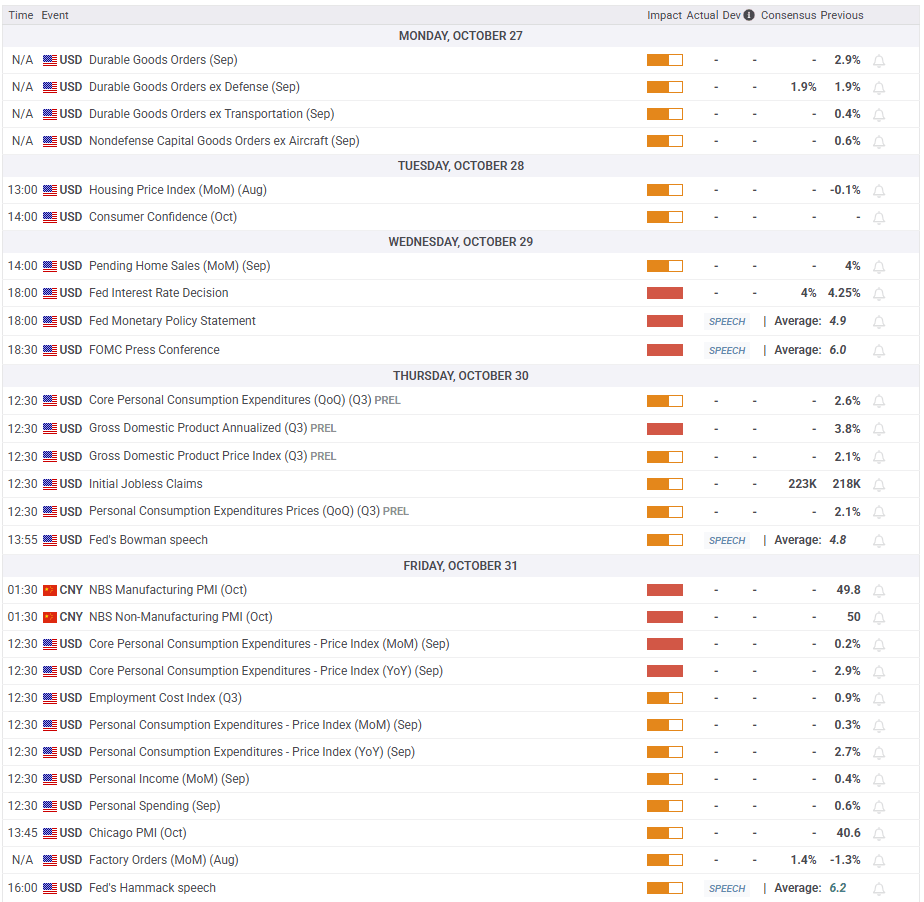
On Wednesday, the Fed will announce its monetary policy decision following a two-day meeting. The CME FedWatch Tool shows that markets are fully pricing in a 25-basis-points (bps) interest rate cut. Because such a decision is unlikely to trigger a market reaction, investors will scrutinize the statement and comments from Fed Chair Jerome Powell in the post-meeting press conference.
In case Powell adopts a cautious tone regarding further monetary policy easing, citing the heightened uncertainty surrounding the inflation outlook and a lack of economic data releases to confirm softening conditions in the labor market, investors could reassess the probability of a rate cut in December. In this scenario, the USD is likely to rise alongside US Treasury bond yields and weigh on XAU/USD.
On the other hand, the USD could struggle to find demand and help XAU/USD hold its ground if Powell notes that they expect the ongoing government shutdown to put additional pressure on the labor market and consumer activity. Nevertheless, the market positioning suggests that the USD doesn’t have much room left to the downside, even if investors are convinced of another 25 bps cut in December. According to the CME FedWatch Tool, markets are already pricing about a 92% chance of the Fed policy rate coming down to 3.5%-3.75% range by December from 4%-4.25%, where it currently stands.
The Asia-Pacific Economic Cooperation (APEC) Forum will be held in South Korea from October 30 to November 1. Chinese President Xi Jinping and US President Trump are expected to meet to discuss trade relations. If sides can avoid an escalation of the conflict by coming to terms on China’s proposed export controls of rare earths and the US’s increased tariff threats, Gold could lose interest as a safe-haven and continue to weaken. Conversely, Gold could start pushing higher if the Xi-Trump meeting is called off or if the sides fail to find a middle ground to extend the trade truce.
Gold technical analysis
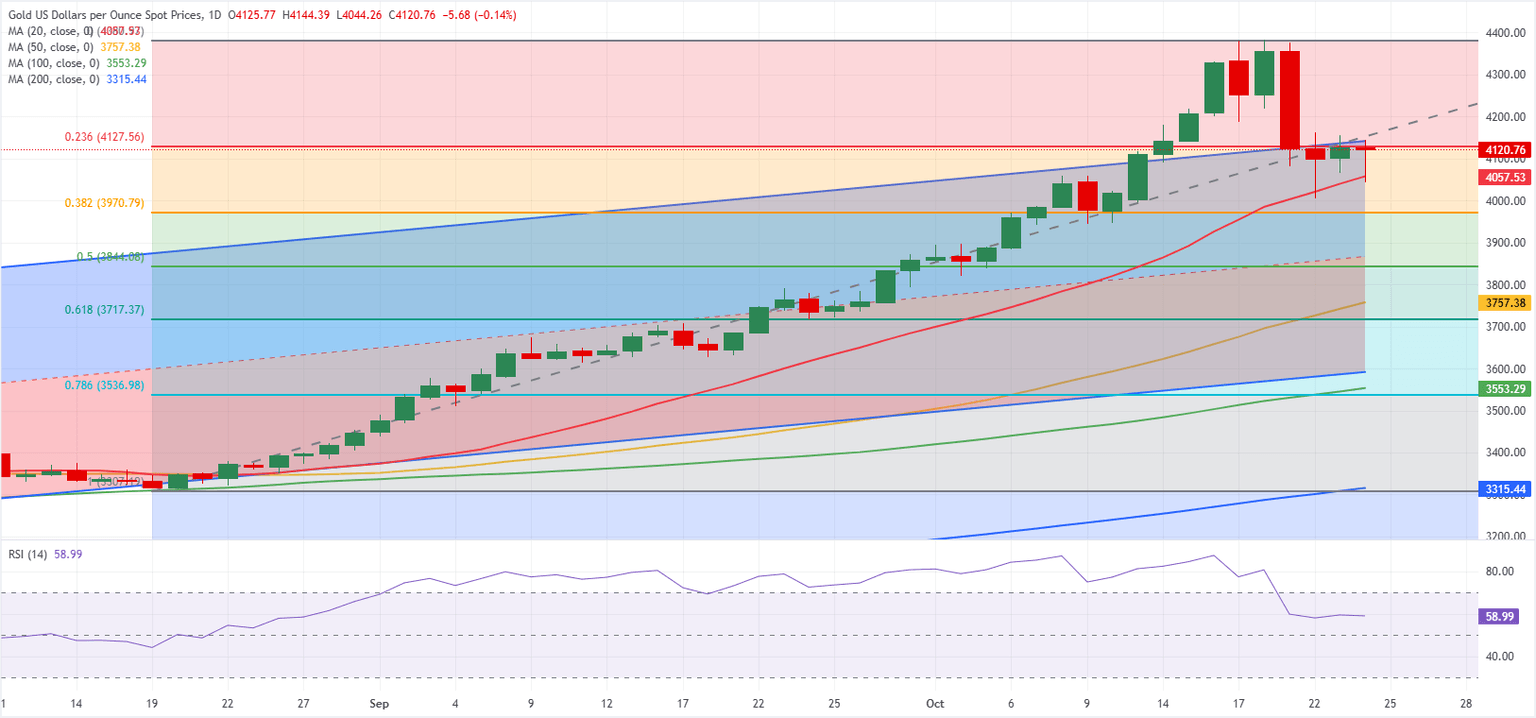
Gold returned to the six-month-old ascending regression channel and the Relative Strength Index (RSI) indicator on the daily chart dropped below 60, showing that XAU/USD finally corrected its overbought conditions. This technical development also highlights a loss of bullish momentum, while the long-term uptrend coming from January remains intact.
On the downside, $4,000 (round level, static level) aligns as an interim support level before $3,970 (Fibonacci 38.2% retracement of the August-October rally) and $3,870-$3,845 (mid-point of the ascending channel, Fibonacci 50% retracement). Looking north, the first resistance area could be spotted at $4,130-$4,140 (upper limit of the ascending channel, Fibonacci 23.6% retracement) ahead of $4,200 (round level, static level) and $4,380 (record-high).
Fed FAQs
Monetary policy in the US is shaped by the Federal Reserve (Fed). The Fed has two mandates: to achieve price stability and foster full employment. Its primary tool to achieve these goals is by adjusting interest rates.
When prices are rising too quickly and inflation is above the Fed’s 2% target, it raises interest rates, increasing borrowing costs throughout the economy. This results in a stronger US Dollar (USD) as it makes the US a more attractive place for international investors to park their money.
When inflation falls below 2% or the Unemployment Rate is too high, the Fed may lower interest rates to encourage borrowing, which weighs on the Greenback.
The Federal Reserve (Fed) holds eight policy meetings a year, where the Federal Open Market Committee (FOMC) assesses economic conditions and makes monetary policy decisions.
The FOMC is attended by twelve Fed officials – the seven members of the Board of Governors, the president of the Federal Reserve Bank of New York, and four of the remaining eleven regional Reserve Bank presidents, who serve one-year terms on a rotating basis.
In extreme situations, the Federal Reserve may resort to a policy named Quantitative Easing (QE). QE is the process by which the Fed substantially increases the flow of credit in a stuck financial system.
It is a non-standard policy measure used during crises or when inflation is extremely low. It was the Fed’s weapon of choice during the Great Financial Crisis in 2008. It involves the Fed printing more Dollars and using them to buy high grade bonds from financial institutions. QE usually weakens the US Dollar.
Quantitative tightening (QT) is the reverse process of QE, whereby the Federal Reserve stops buying bonds from financial institutions and does not reinvest the principal from the bonds it holds maturing, to purchase new bonds. It is usually positive for the value of the US Dollar.



